Edomae Sushi
- 東京鮨toukyouzushi
- 江戸鮨edozushi
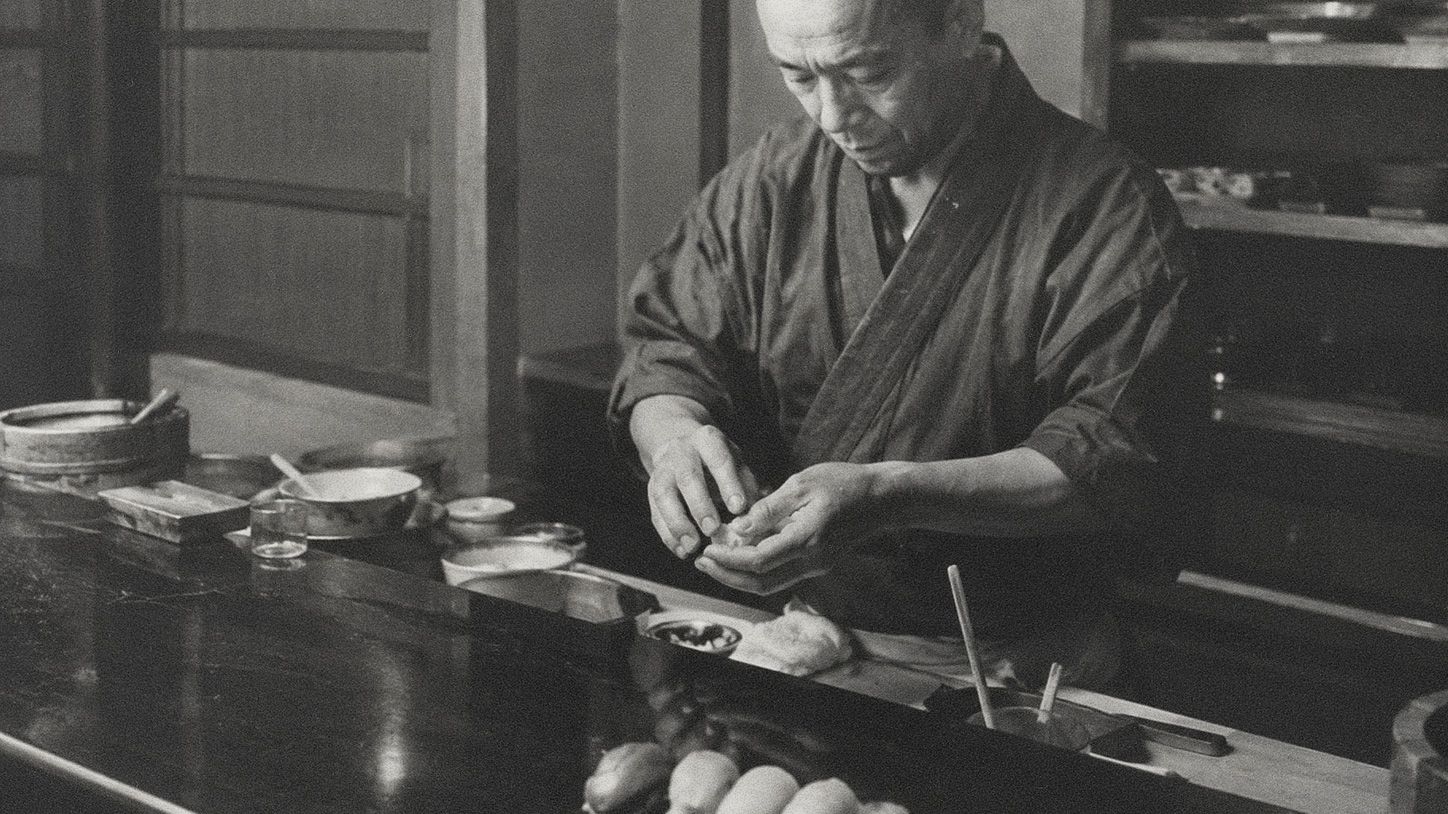
A sushi shokunin at the tsukeba (付け場, sushi counter) shaping nigiri sushi. At the center of the Edomae form is the hand-formed bite: a small amount of rice, pressed by hand, paired with a single main ingredient, and served immediately.
AI-generated photo: Edomae sushi shokunin. © SUSHIPEDIA
Edomae sushi (edomaezushi, 江戸前寿司, sushi in the Edo style) is the canonical name for the hand-formed style of sushi developed in early-19th-century Edo (present-day Tokyo) and, by the second half of the 20th century, the dominant style of sushi served in Japan and abroad.1, 2 A piece consists of a small amount of shari (舎利, vinegared rice) pressed by hand to fit a single neta (sushi topping), which has typically been pretreated by curing, marinating, simmering, or a similar preparation. The form is consumed in one bite; in its 19th-century origin it was street food, served at yatai (屋台, food stalls) to the working population of Edo.2, 3
Definition and scope
The term has carried two coexisting senses since the late 19th century. The narrow sense denotes sushi made from seafood landed in Tokyo Bay — historically the bay immediately offshore of Edo Castle — and prepared by the techniques codified during the Edo period. The broad sense, dominant in present-day usage, denotes the counter-style sushi served at a sushiya (寿司屋, sushi establishment) by a sushi shokunin (寿司職人, sushi artisian), regardless of where the seafood was landed and regardless of whether the historical preparation techniques are used.1
The Tokyo Bay provenance question was addressed in 2005 by a subcommittee of Japan's Fisheries Agency (水産庁), which proposed defining "Edomae" as fresh seafood taken from anywhere within Tokyo Bay: the area enclosed by a line from Cape Tsurugizaki on the Miura Peninsula to Cape Sunosaki on the Bōsō Peninsula. The definition was published as the subcommittee's personal view rather than as an official agency position, and does not bear on the broader culinary use of the term.4 The historical fishing grounds, the immediate waters off Tsukuda and Shinagawa, have been almost entirely lost to land reclamation since the Meiji period,5, 6 and the proposed widening reads as an attempt to keep "Edomae" usable as a present-day quality marker for inner-bay catch.6
Origins in late Edo
The form's emergence is documented to the Bunsei era (1818–1830).1 A commonly cited early written reference to nigiri appears in the senryū collection Haifū Yanagidaru (誹風柳多留): “Yōjutsu to iu mi de nigiru sushi no meshi” (妖術という身で握る鮓の飯). The verse draws its effect from the hand movement itself: sushi rice shaped by hand is likened to a conjurer’s trick, suggesting that the technique still appeared visually striking in early nineteenth-century Edo popular culture.
The figure most commonly named as the form's developer is Hanaya Yohei (華屋与兵衛, 1799–1858), who opened a sushi shop named Hanaya in the Ryōgoku district of Edo in 1824.3 A later family account preserved by Koizumi Seizaburō, the younger brother of the fourth-generation Yohei, describes the founding Yohei's innovation as nigiri-hayazuke (握早漬, hand-formed quick-pickle) and credits him with rejecting the slow, weighted preparation of box sushi in favor of pieces shaped to order and served immediately.7 Whether Yohei was strictly the first to attempt hand-formed sushi is contested in the same family record, which mentions earlier attempts that failed commercially.7 What is reliably attributable to him is the popularization of the form, the introduction of wasabi between rice and topping, and the establishment of Hanaya as one of the three sushi shops by which late-Edo sushi was best known: the so-called Edo-sanzushi (江戸三鮨, the three sushi of Edo), alongside Sakaiya Matsugorō's Matsugazushi and the older Kenuki-zushi.3, 7
Defining preparations
Without refrigeration, raw seafood spoiled within hours in Edo's summer heat. Edo-period sushi makers responded by treating each species in the way most likely to preserve it and bring out its flavor, and the resulting set of preparations is what most strongly distinguishes Edomae sushi today: white-fleshed fish were cured between sheets of kelp (kobujime, 昆布締め); silver-skinned fish, the hikarimono (光り物, "shiny ones"), were pressed in salt and vinegar (sujime, 酢締め); tuna was steeped in soy sauce (zuke, 漬け); cooked seafood — anago (穴子, saltwater eel), octopus, the inside of clams — was simmered in dashi-soy broths and brushed at service with a sweet reduction known as tsume (詰め).1, 2 Each finished piece was brushed with a coat of nikiri (煮切り, soy reduction) in place of a dipping bowl.2 Each individual technique predated edomaezushi, but their integration into a menu of bite-sized pieces is what defines the Edomae idiom and distinguishes it from the otherwise-similar Kansai box and pressed sushi.1
The vinegar in early Edomae shari was not the mild rice vinegar standard in most contemporary sushi but kasuzu (粕酢, sake-lees vinegar), also called akazu (赤酢, red vinegar) for its reddish-brown color. Kasuzu was developed in the early 19th century by Nakano Mataemon of present-day Handa, Aichi — the founder of what is now the Mizkan corporation — by fermenting the lees left from sake brewing.3 It was both cheaper and more strongly flavored than rice vinegar, and the resulting tinted shari became one of the marks of Edo-period sushi.3 Kasuzu remained standard into the postwar period, when shortages and the early-1950s "yellow rice" contamination (grains with toxigenic Penicillium) episode pushed the trade toward rice vinegar; akazu has since been revived deliberately by traditionalist sushiya as a marker of Edomae authenticity.1
From Edo street food to national standard
Through the 19th century Edomae sushi was unambiguously Edo's local cuisine; the rest of Japan ate the older box, pressed, and fermented styles. Two events of the 20th century made it the de facto national style. The Great Kantō Earthquake of 1923 (関東大震災) destroyed much of central Tokyo, and Tokyo sushi makers displaced from their shops took work in Kansai and other regions, where their hand-formed style began to compete with and gradually displace local box and pressed traditions.1 The second event was the postwar food-rationing regime: from July 1947 to April 1949, sushi shops were permitted to operate only under a "consignment processing" arrangement (寿司委託加工制度) in which a customer brought one gō (合) of rice and received ten pieces of nigiri sushi or four maki rolls in exchange.1 The arrangement, negotiated by the Tokyo sushi-trade association with the occupation authorities, was rapidly copied nationwide; for a period sushi shops across Japan offered only nigiri-style Edomae sushi.1 When the controls lifted, the Edomae form had become the default.
Two later developments completed the picture. From the 1960s the higher-end sushiya moved from outdoor stalls to seated indoor counters, a shift the food critic Kitaōji Rosanjin remarked on at the time, contrasting prewar stand-up sushi with the postwar seated counter.1 Conversely, conveyor-belt kaitenzushi (回転寿司, "rotation sushi"), beginning in 1958 with Genroku-zushi in Osaka and spreading nationally from around 1980, returned a stripped-down version of the form to the casual price point Edomae had originally occupied.1 Both ends of the contemporary market, the high-end omakase counter and the conveyor-belt chain, descend from the same Edomae template.
Etymology
The compound combines edomae (江戸前) with zushi, the rendaku-voiced form that sushi takes in compounds.8 The prefix edomae meant literally "in front of Edo" and originally referred to the fishing grounds immediately offshore of Edo Castle. By the early Edo period these were the waters around Tsukuda Island and the mouth of the Sumida River.9 The dictionary tradition records its earliest documentary attestation in an 1854 government order, where it denotes the bay area itself.10 The earliest gastronomic use is not for sushi but for eel: through the second half of the 18th century edomae was applied specifically to kabayaki (蒲焼, charcoal-grilled glazed eel) from Edo's waters, distinguished from "traveling eel" (tabi-unagi, 旅鰻) imported overland.10, 11, 12 Mitamura Engyo's Edo no Shoku Seikatsu notes that edomae appears so consistently in eel contexts from the Hōreki era (1751–1764) onward that one might suppose the term was made for eel.13 Its application to nigiri sushi followed the form's emergence in the 1820s and was already fixed by the time of the first written attestations a few years later.1
Related Terms
References and Further Reading
- [1]『江戸前寿司』 (Edomae sushi). Wikipedia (Japanese). Source retrieved 5/5/2026
- [2]Aoki Toshikatsu (interview). "Edomae" Sushi: A Fast Food with a Long Tradition. Nippon.com, 2014. Source retrieved 5/5/2026
- [3]『すしの歴史(4) 江戸の握り寿司文化と華屋与兵衛』 (History of Sushi (4): Edo's Nigiri-zushi Culture and Hanaya Yohei). 株式会社Mizkan (Mizkan). Source retrieved 5/5/2026
- [4]『江戸前』 (Edomae). Wikipedia (Japanese). Source retrieved 5/5/2026
- [5]来生新, 菱田昌孝. 『江戸前の東京湾は呼び戻せるか』 (Can the Edomae Tokyo Bay Be Recovered?). 笹川平和財団 海洋政策研究所 (Sasakawa Peace Foundation, Ocean Policy Research Institute). Source retrieved 5/5/2026
- [6]福地享子. 『「江戸前の魚」って何ですか?その変遷と今』 (What is 'Edomae fish'? Its evolution and today). 料理王国 (Cuisine Kingdom). Source retrieved 5/5/2026
- [7]小泉清三郎 (迂外). 『家庭魓のつけかた』 (A Household Method of Preparing Sushi). 大倉書店 (Ōkura Shoten). 1910
- [8]『デジタル大辞泉』 (Daijisen Japanese Dictionary (digital edition)). 小学館 (Shogakukan). Source retrieved 5/5/2026
- [9]『ブリタニカ国際大百科事典 小項目事典』 (Britannica International Encyclopedia, Concise Edition). ブリタニカ・ジャパン (Britannica Japan). Source retrieved 5/5/2026
- [10]『精選版 日本国語大辞典』 (Selected Edition of the Comprehensive Japanese Dictionary). 小学館 (Shogakukan). Source retrieved 5/5/2026
- [11]『鰻のかば焼き 東京都』 (Eel Kabayaki (Tokyo Prefecture local-cuisine entry)). 農林水産省 (MAFF). Source retrieved 5/5/2026
- [12]『江戸前といえば鰻のこと(夏)』 ("Edomae" Means Eel (Summer Edition)). 味の素食の文化センター (Ajinomoto Foundation for Dietary Culture). Source retrieved 5/5/2026
- [13]三田村鳶魚. 『江戸の食生活』 (Eating in Edo). 中央公論社 (Chūōkōronsha). 1975