Yuzu
- 鬼橘onitachibana
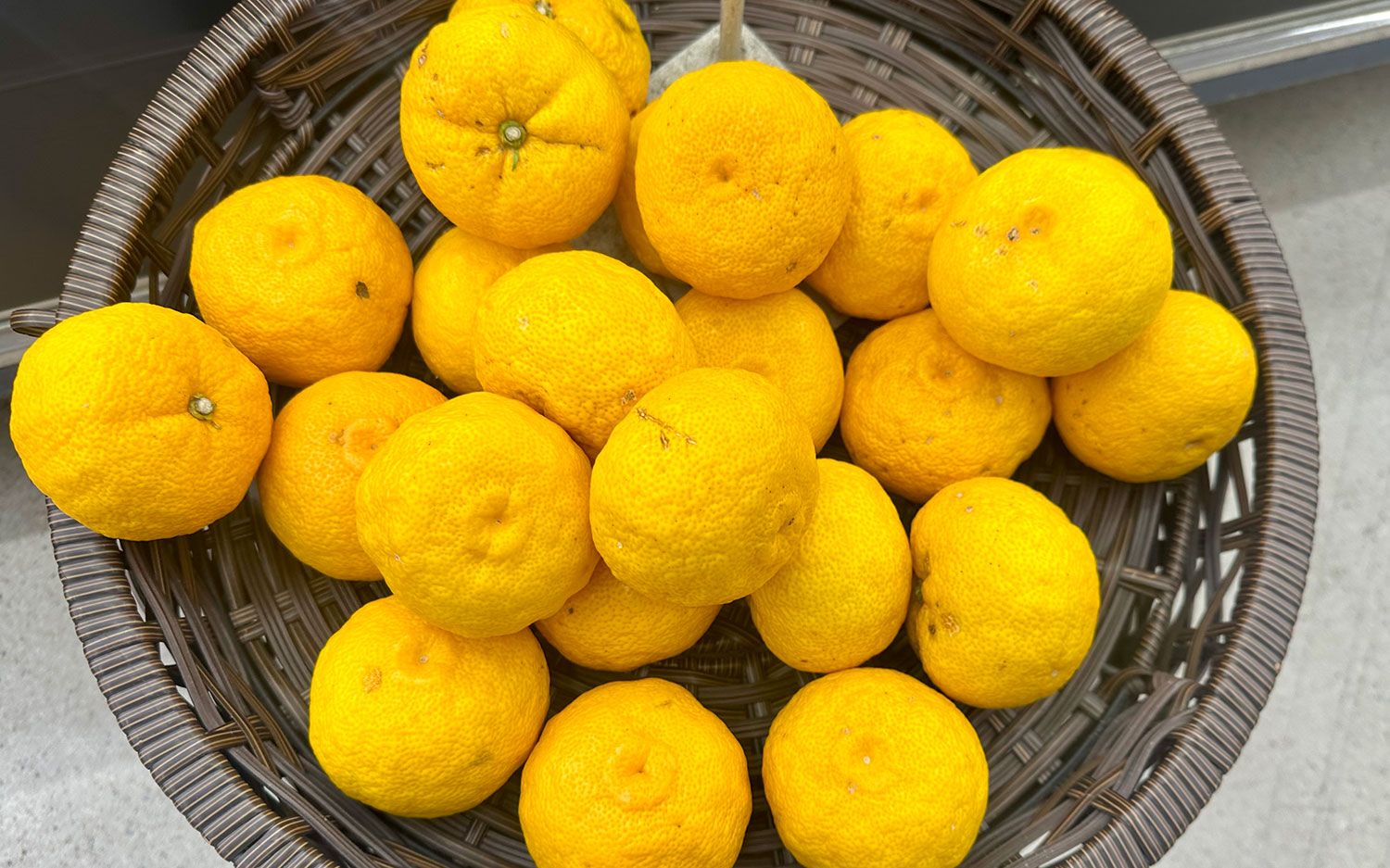
Yuzu (Citrus × junos, 柚子). Wikimedia Commons. © Nesnad. Some rights reserved: CC BY 4.0. Changes applied: crop
Yuzu (柚子) is an aromatic citrus, Citrus junos, that occupies a near-singular role in Japanese cuisine: it is grown and used almost entirely as a seasoning rather than as a fruit eaten on its own.1, 2 The fruit is yellow at maturity, weighs roughly 100 to 130 grams, carries about six percent acid (most of it citric), and yields only fifteen to twenty percent of its weight as juice; the flesh is too sour for raw eating, and the fruit's value lies in the aroma carried by the peel and in the juice's bright, complex acidity.1, 2
In Japanese cooking the peel is shaved thin to float as a suikuchi (吸口, finishing aroma) on clear soups, julienned to garnish grilled and simmered dishes, or grated to be folded into miso for yuzumiso (柚子味噌).1, 2 The juice is added to soy sauce as a dressing for sashimi, in the same role that daidai (橙, bitter orange) and sudachi (酢橘) play, and is the citrus base of ponzu.1 Across these uses the fruit functions as a seasoning citrus in the strict sense: it adjusts aroma and acidity rather than supplying body or sweetness.3
At the sushi counter the same logic applies. The documented application is in the soy-based dipping sauces served with sashimi-cut and white-fleshed neta (sushi toppings), the citrus-spiked soy and ponzu-style accompaniments offered with white-fleshed fish and shellfish, where yuzu juice supplies acidity and aromatic lift without competing with the neta itself.1 Slivered or grated peel is used in the same supporting register, as a finishing aroma on subtler preparations; the volatile oils responsible for the aroma sit in small translucent vesicles on the peel's outer surface and release on contact.2
Yuzu has two culinary stages in the year. The green, immature fruit, harvested August through September, is used for its sharper, more piercing aroma and higher acidity; the yellow ripe fruit dominates from late October onward.1 Late-October harvest, taken at roughly seventy to eighty percent coloration, holds the most juice; full yellow coloration arrives in mid- to late November, and the fruit is held at two to five degrees Celsius and shipped through to about March.1 This seasonality is the practical reason yuzu peel appears more prominently on autumn and winter menus.
Yuzu is the most cold-tolerant of Japan's citrus and grows as far north as the Tōhoku coast.1, 2 Production is concentrated in three Shikoku prefectures: Kōchi accounts for roughly half of Japan's annual yield, followed by Tokushima and Ehime as the second and third producers.4 Outside Japan the species is barely cultivated; commercial production is overwhelmingly Japanese.1
The species originated in the upper reaches of the Yangtze and reached Japan in ancient times by way of the Korean peninsula.1, 2 An older Japanese name, onitachibana (鬼橘, "demon tachibana"), referred to the fruit's coarse peel relative to the smoother tachibana citrus.1 The kanji 柚 has diverged across the two languages: in modern Chinese it now refers to the pomelo, while Japanese 柚子 has retained the older referent.1 The reading is irregular: 柚 alone can be read yu, yū, or yuzu, and the compound 柚子 reads yuzu as a fixed lexical form rather than as a transparent kanji compound.3
References and Further Reading
- [1]山田彬雄. 『ユズ』 (Yuzu (Citrus junos)). 平凡社 (Heibonsha). Source retrieved 4/14/2026
- [2]飯塚宗夫. 『ユズ』 (Yuzu (Citrus junos)). 小学館 (Shogakukan). 2020. Source retrieved 4/14/2026
- [3]『大辞泉』 (Daijisen Japanese Dictionary). 小学館 (Shogakukan). Source retrieved 4/14/2026
- [4]『ゆず | 日本産食材ピックアップ』 (Yuzu | Japanese Food Ingredients Pickup). 日本貿易振興機構 (JETRO). Source retrieved 4/14/2026